Recommended Reading
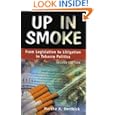 |
Up In Smoke: From Legislation To Litigation In Tobacco
Politics
by Martha A. Derthick
Martha Derthick introduces new
evidence from 5 years of experience under the MSA to show that the states were
more interested in raising revenue than in improving tobacco control, that the
enrichment of wealthy tort lawyers violated the legal profession's ethics, and
that the agreement, ironically, spawned the rise of small, upstart cigarette
manufacturers able to undersell the major companies. In this clearly written,
fast-paced case study, Derthick concludes that the tobacco lawsuits not only
produced flawed public policy that flouted the American system of checks and
balances, but has done little to improve or better safeguard public health.
|
| |

|
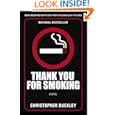 |
Thank You for Smoking
by Christopher Buckley
Christopher Buckley's satirical gift shines in this hilarious look at the
ironies of "personal freedom" and the unbearable smugness of political
correctness. Bracing in its cynicism, Thank You for Smoking is a delightful
meander off the beaten path of mainstream American ethics. And despite his
hypertension-inducing, slander-splattered, morally bankrupt behavior--which
leads one Larry King listener to describe him as "lower than whale
crap"--you'll find yourself rooting for smoking's mass enabler. --Rebekah
Warren |
| |
|
 |
Cancer Scam: Diversion of Federal Cancer Funds to
Politics
by James T. Bennett, Thomas J. Dilorenzo
According to
James T. Bennett and Thomas J. DiLorenzo, authors of Cancerscam, smoking can be
good for society, if not for the smoker. Consider all the money the government
could save, for instance, on social security if millions of people die young
from smoking-related illnesses. Much of Bennett and DiLorenzo's book is taken
up with their argument that the government's campaign against smoking is
intrusive and unwarranted. They liken smoking to other hazardous choices such
as skydiving or skateboarding and point out that there is no national campaign
to educate practitioners of these activities. They then launch into an attack
on the National Cancer Institute and the American Cancer Society, which they
accuse of diverting funds into an antismoking program run by a left-wing public
interest organization. Cigarette manufacturers and major stockholders in
tobacco companies will love this book; those who deal with the medical, social,
and personal fall-out from smoking, on the other hand, will find little to
agree with here. |
| |
|
 |
Slow Burn : The Great American Antismoking Scam
(And Why It
Will Fail)
by Don Oakley
"Slow Burn" is a highly personal but
thoroughly documented journey by the author, Don Oakley, to find out the truth
behind the supposed medical facts undergirding the nation's three-decades-long
crusade against smoking. He begins with a searching critique of the 1964
surgeon general's report, which set the crusade into motion, and details the
reservations of the surgeon general's advisory committee regarding the seven
weak studies which formed the basis for the famous warning that "Cigarette
smoking is a health hazard of sufficent importance in the United States to
warrant appropriate remedial action." It was that "action"--or, more
accurately, actions--flowing from the report over the past three decades that
persuaded the author, a retired newspaper editorial writer, to undertake his
book. |
| |
|
 |
Does Advertising Increase Smoking?
Economics, Free Speech and
Advertising Bans
by Hugh High
|
|
|

|
For Your Own Good : The Anti-Smoking Crusade and the Tyranny of
Public Health
by Jacob Sullum
In this controversial book,
Jacob Sullum demolishes the leading claims of the antismoking movement; their
assertions have been advanced, he says, because the movement's principals would
like the government to take control of the tobacco industry. Have you heard
that secondhand smoke is bad for you? "There is no evidence that casual
exposure to secondhand smoke has any impact on your life expectancy," writes
Sullum, a drug policy expert and senior editor at Reason magazine. The debate
over smoking is really more about the nature of liberty--how should a society
restrict the choices of its members?--than it is about public health. |
| |
|
 |
The People Vs. Big Tobacco : How the States Took on the Cigarette
Giants
by Carrick Mollenkamp (Editor), Adam Levy, Joseph Menn
(Editor), Jeffrey Rothfeder (Editor)
The People Vs. Big Tobacco: How the
States Took on the Cigarette Giants is a blow-by-blow account of how the
"Mother of All Lawsuits" was eventually settled, who the major players were,
and what the settlement actually means for the future of Big Tobacco. |
|
|
 |
Cornered : Big Tobacco at the Bar of Justice
by Peter
Pringle
There are many threads to be pulled together, and Peter Pringle
pulls them nicely.... Cornered, in its meticulous explanation, is finally an
illustration of what's wrong with using the courts--or a regulatory agency, for
that matter--to resolve a social mess. |
| |
|
 |
The Nazi War on Cancer
by Robert N. Proctor
Familiar as we are with the horrific history of Nazi medicine and science, it
may come as a surprise to learn that the Nazi war against cancer was the most
aggressive in the world. Robert N. Proctor's thought-provoking book, The Nazi
War on Cancer recounts this little-known story. The Nazis were very concerned
about protecting the health of the "Volk." Cancer was seen as a growing
threat--and perhaps even held a special place in Adolf Hitler's imagination
(his mother, Klara, died from breast cancer in 1907). The Nazi doctors fought
their war against cancer on many fronts, battling environmental and workplace
hazards (restrictions on the use of asbestos) and recommending food standards
(bans on carcinogenic pesticides and food dyes) and early detection ("men were
advised to get their colons checked as often as they would check the engines of
their cars..."). |
| |
|
 |
Silencing Science
by Michael Gough, Steven J.
Milloy
Science has been a major contributor to the health and wealth we
enjoy today, but not everyone is happy with it. Science can get in the way of
social and environmental activists, politicians, lawyers, and government
regulators. This book is a tongue-in-cheek "how-to" manual for the concerned
citizen annoyed by "pesky" science. The authors describe more than 20 efforts
of individuals and organizations to stop science in its tracks using techniques
ranging from defunding scientific research to squashing scientific debate to
substituting "junk" science for real science. Their witty descriptions
illuminate the mischief that has followed successful and all-to-real efforts to
thwart true science and offer stark reminders of the risks that follow when
real science is silenced. |
|

|
|

